Perspectives // Thought Leadership

Member
Contributions

"Insights, reflections, and wisdom shared by members of our District."

In The Middle:
The Quiet Burden

By Samantha Ndekana

I learned early that leadership does not always arrive with permission. Sometimes it arrives as expectation. Sometimes as silence in a room where someone must speak. Sometimes as responsibility handed to you long before you feel ready to carry it.

Growing up, I often found myself in positions of leadership I did not campaign for. I was the firstborn daughter. The first grandchild. The one expected to know better, do better, hold things together. In school, teachers chose me not because I demanded authority, but because I was proactive, well-mannered, reliable. I followed rules. I noticed what needed to be done. I stepped in.

Looking back, I realize I was often placed in the middle — between chaos and calm, between instruction and execution, between adults who led loudly and children who were expected to comply.

At the time, I thought this was simply what leadership looked like. But as I grew older, I began to see the pattern more clearly.

In many of our cultural spaces, leadership is portrayed as dominance — the one with the final say, the unchallenged voice, the person who gives orders and sets rules they themselves sometimes struggle to follow. Leadership is loud. Unyielding. It demands obedience more than it models integrity.

And yet, what we are often starving for is not direction. It is example. We do not need more commands. We need more integrity. More kindness. More respect practiced consistently, not preached occasionally.

For young African women, this absence is especially painful. Our voices are powerful — and that power is complicated. Sometimes our voices become weapons we must use to defend ourselves. Other times, they are thrown back at us, sharp and unrecognizable. We are taught early that speaking comes at a cost.

When a woman speaks up, she must calculate the consequences first:

  • Watch her tone.
  • Soften her words.
  • Smile while asserting herself.

"The same conviction that earns a man the title 'leader' often earns a woman the label 'bitter'."

So we learn to live in tension. To exist in the middle of knowing what must be said and deciding whether it is safe to say it. In the middle of respect and responsibility. In the middle of tradition and transformation.

Being in the middle is exhausting. It means being the driving force of change without applause. It means modeling what you have never seen so that the women after you might have a blueprint. It means being firm enough to say no, to hold your ground — but gentle enough not to lose yourself in the process.

Many of our mothers carried their leadership with pain. They endured. They swallowed. They survived. And for that, we honor them deeply. But some of us are choosing something different. We are choosing to lead with warmth.

To correct and still comfort. To reprimand and still give hugs. To be firm without becoming hard. This choice is not accidental. It is intentional. And it is costly.

Systems that reward volume over values will always resist women who lead quietly but consistently. Kindness is still mistaken for weakness. Silence is still safer than honesty in many rooms. And yet, growth has never been comfortable for those brave enough to stand in the middle.

This is why spaces like Toastmasters surprised me. Unlike many traditional environments, Toastmasters is a levelled plain — a practice ground for the kind of leadership I was still learning to claim. Here, voice is not inherited; it is practiced. Authority is not assumed; it is earned through preparation, listening, and growth. Feedback is not an attack; it is an offering.

In this space, I am allowed to speak without shrinking. I have learned to stand and share my thoughts knowing that I will not be interrupted, dismissed, or rushed — that my voice will be received with attention, even when it is still finding its strength.

I am allowed to lead without shouting. Through meeting roles and leadership opportunities, I have seen that authority here comes not from volume, but from preparation, consistency, and service. I have learned that it is possible to guide a room firmly while remaining calm, respectful, and composed.

And I am allowed to grow without being hardened. Feedback is offered with care, evaluations are balanced with encouragement, and mistakes are treated as part of the process rather than personal failures. In this environment, growth does not require armor — only willingness.

Breaking cycles does not require grand speeches or dramatic rebellion. It requires small, repeated choices — to respond instead of react, to lead by example, to speak with courage and care even when it would be easier to stay quiet.

Being in the middle is not weakness. It is responsibility. And for women willing to stand there — especially African women — it is a quiet, radical act of leadership.

When a Single Nod
Changes Everything

By Sajida Z. Master

I still remember my Ice Breaker speech.

I had prepared. I had practiced. And yet, midway through the speech, my mind went completely blank. I stood there, stuck, unsure of the next word, the next thought, or the next step. In that moment, the room felt very quiet.

Then I saw my mentor. They did not interrupt. They did not mouth words or rush to help. They simply gave me a small, calm nod, one that said, “Take your time. You can do this.”

That nod grounded me. I paused, took a breath, and continued. I finished my speech. More importantly, I walked away believing I belonged on that stage. That moment taught me something lasting.

"Mentorship does not always need words. Sometimes, belief is enough."

Toastmasters places strong importance on mentorship because growth is personal. Resources and evaluations help build skills, but mentorship supports the emotional journey, especially in the early stages.

At the district level, strong mentorship translates into stronger clubs, better leaders, and higher member engagement. Members who feel supported are more likely to stay, serve, and step into leadership roles.

Many clubs assign mentors, and that is a good start. But real mentorship does not end with a name on a form. True mentorship is intentional. It is checking in, asking questions, listening, and encouraging growth beyond just completing projects. It is about being present, especially during moments of uncertainty or self-doubt.

So, How can we Implement Better Mentorship in Our Clubs?

1. Make expectations clear
A mentor does not need to do everything. However, both mentor and mentee should understand what support looks like. A short conversation about goals, availability, and focus areas can make a meaningful difference.

2. Encourage conversations, not just corrections
Mentorship is not only about fixing speeches or pointing out areas of improvement. It is about helping members find their voice, set personal goals, and stay inspired throughout their journey.

3. Create better matches
When possible, mentors and mentees should be matched based on shared goals, interests, or communication styles. A good connection builds trust and makes the relationship more effective.

4. Recognize mentors openly
A simple thank-you during a meeting or a mention in a newsletter goes a long way. Recognition reinforces the value of mentorship and encourages more members to step forward.

5. Build a culture of support
The strongest clubs are those where mentorship happens naturally. Peer to peer support, member to member encouragement, and consistent positive feedback help mentorship become a habit rather than a program.

You do not have to be an expert to be a mentor. You simply need to notice someone who might need encouragement.

Let us build clubs where no one feels stranded on the stage, where every member knows someone is silently cheering them on. Because sometimes, the smallest gesture becomes the moment someone discovers their confidence.


The Healing Roundabout &
The Outloving Expressway

By Dagmawi Bedilu

After a rejection, you’ll find yourself at a Y junction (a threeway road). One road leads to obsession, addiction, and infatuation of the one/thing that was lost and the other leads to hate, anger and resentment towards the one/thing that was lost.

But if you take the time and look closely and analyze the Y junction you are standing on, you’ll soon figure out that you are in fact not standing on a Y junction but at a crossroad (a + junction) and there are not three but four pathways from where you are standing (the 4th one being the one you came from which has little to none chance of being an option).

The two directions, the one that leads to the right and the one that leads to the left both go sideways and never ahead. Neither one leads to progress only stagnation on the spot.

But the blurry one that’s ahead, now that’s the road to progress, the road of moving on. So what does this road offer? I call this road the OutLoving Expressway. It has its procedure:

1. Diagnosis
The first step is understanding rejection is not an emotion but a mixture of various emotions, to be specific. One is the sense of Unreciprocated Love due to the fact the person/thing you hoped to make your own either doesn’t feel the same way, or even if they did feel the same way it they’re impossible to get due to the circumstances, timing and other factors leaving you holding love that no-one is willing to take.

And the second emotion is the sense of Unworthiness. You feel you don’t deserve love or that you are unwanted, you are a lesser being. You are not worthy of anything that is good and the world has rejected you completely and that the only thing that’s left for you in the future is pain and suffering.

Understanding this — that you’re working with not one but two emotions — is like a doctor realizing for the first time from his/her patient’s symptoms that the patient has two diseases and not one. This enables him to diagnose both rather than trying to come up with one diagnosis for both assuming the patient has only one disease. This leads the doctor treating the wrong disease or even making it worse by the medication he is prescribing. And the same goes for rejections; once you know you are working with two emotions you can manage them separately without one remedy affecting the other.

2. Dealing with Unreciprocated Love
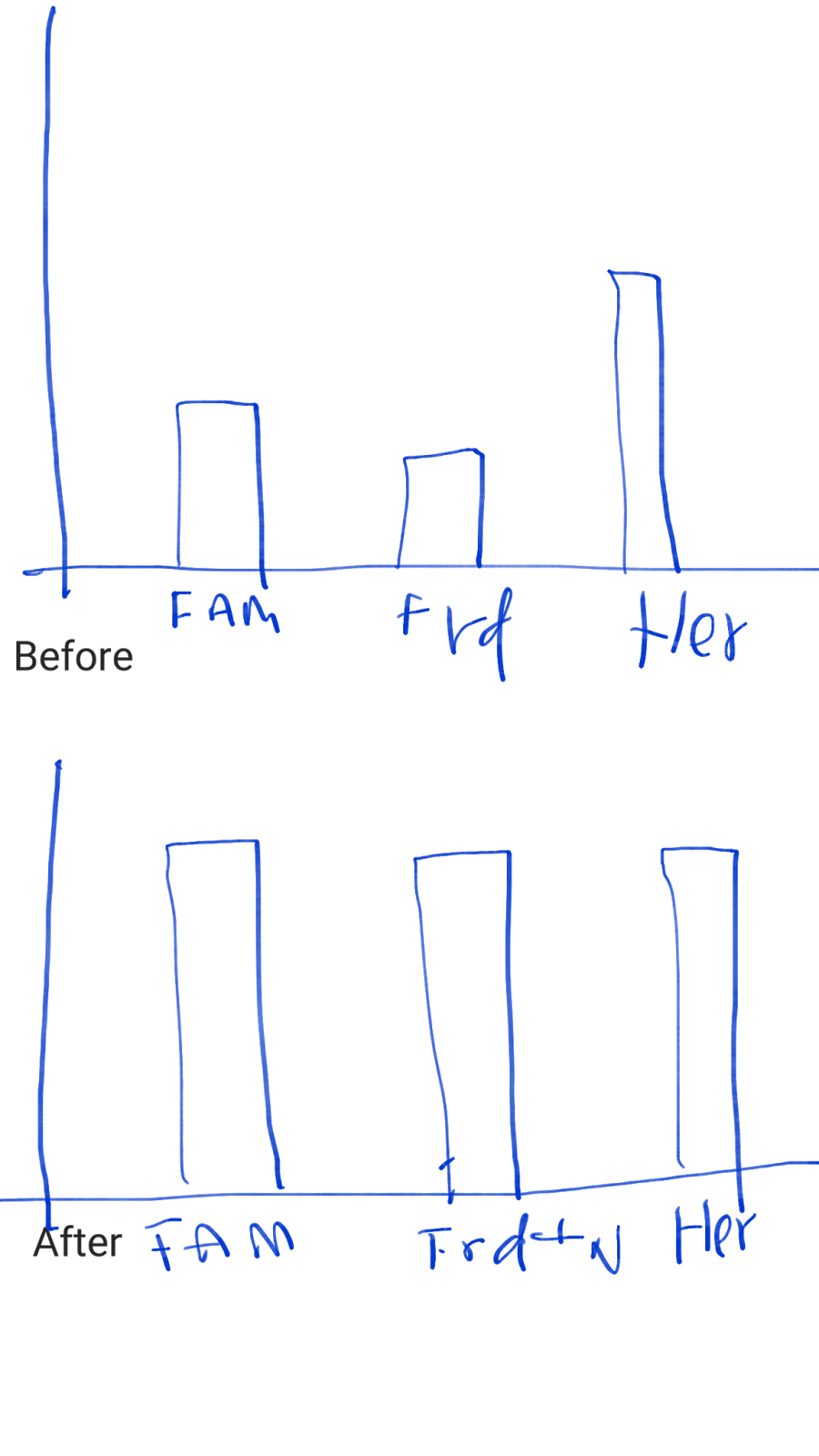
For the Unreciprocated Love, you will go to a place where you’re sure they will receive your love; to friends and to family, to the helpless. You’ll up the game. You start showing affection to those who do love you. That by itself might not be sufficient, you might need to go out and start meeting new people while strengthening the already existing bonds (friends and family). The best way to do this is to join clubs (volunteer) or start fun classes (cooking, dancing…).

And immediately you start to notice the love that seemed so big for that particular person/thing who’ve rejected you being equated in magnitude. Now you need to remember one thing, your aim is healing and not getting cured which is much better in the sense you’ll be stronger and more immune to your previous self.

Graph showing decline in overloving

The graph for before and after overloving experience

3. Dealing with Self-Worth
For the decline in self-worth, you need to start working on your hobbies, dreams and that personal projects you were putting off for later. The best remedy for regaining self-worth is to find one's purpose in life, to be of importance, to serve those who need it. And in this, one can regain self-worth. One needs to do this not for the sake getting over a crush but to even get through life in the most graceful way.

Some say heartbreaks are the best time to do life transformation in all aspects (lifestyle, fashion, eating habits, sports, occupation) because as the great wisdom quote goes:

“For a tree’s branches to stretch into the heavens, its roots must reach into hell.”

And guess what? You’re already in hell and there is only one way to go, which is up.

This is the best time to start a new business or a new endeavor. If you don’t believe me look at all the great thinkers, builders of the world. All the greatest inventions came after a great personal grief. The place you are at, gives you the perfect mix of senses of hopelessness and faithfulness which is the best time for taking that leap of faith. You should say to yourself:

“If I’m bound to fail shooting for the roof; might as well shoot for the stars… at least I’ll enjoy the ride.”

You’ll develop a somewhat crazy confidence in the fact that if realistic goal like a sensible relationship or securing a good job takes all your energy without return, why not completely reverse it and make it enormously big.

Instead of investing all your energy into a single relationship… start a community. Instead of trying to secure a job build one, instead of grieving over the loss of a loved one, celebrate their life by hosting a party.

For there is no problem in life, only challenges. Everything is going to come to an end. We are all going to die, it’s never the question of who gets to live the most nor evading death, the question is making the time between two non-existences, two singularities (pre-birth and death) worth the while.


Strategies for Club
Growth and Retention

By Rashmi Udeshi

Excellence is never accidental—it is built with intent. In the Toastmasters ecosystem, achieving the Smedley Award and going on to accomplish 10 out of 10 Distinguished Club Program (DCP) goals represents the pinnacle of club excellence.

Rooted in focused leadership, intentional service, and a culture of empathy and commitment, Dar Toastmasters’ journey reflects sustainable growth, strong member retention, and consistently rising standards. Our achievement was the result of deliberate strategy and disciplined execution, with member experience placed firmly at the centre of every decision.

Early Momentum with Strategic Clarity

The early achievement of the Smedley Award provided strong momentum. Membership growth was approached with intent—ensuring that the club was not only attracting new members but was equally prepared to engage, integrate, and support them effectively. This foundation created confidence and continuity that carried through the Toastmasters year.

Focused Leadership That Walked the Talk

Leadership focus was a defining factor. DCP goals were treated as indicators of member development rather than administrative targets. Roles were clearly defined, progress was monitored consistently, and accountability was embedded in day-to-day operations.

"Leaders who walk the talk inspire others to follow."

By modelling consistency, participation, and completion of educational goals, the leadership team set a standard that members naturally aligned with.

Service-Oriented Leadership

Guided by the principle that “Leadership is not about being in charge, but about taking care of those in your charge,” the club cultivated trust, engagement, and long-term commitment. Meetings were thoughtfully structured, and evaluations were designed to encourage growth.

Empathy as a Retention Strategy

Empathy played a critical role. Leaders recognised that each member’s journey was unique. New members were welcomed with care, while experienced members were challenged and acknowledged. This empathetic culture fostered belonging and psychological safety—key drivers of retention.

Raising the Excellence Barometer

Excellence became habitual. From meeting quality and role preparedness to speech delivery and evaluations, standards were consciously elevated. Each meeting was viewed as an opportunity to refine processes and enhance member experience.

By consistently raising the bar and aligning purpose with people, Dar Toastmasters has set a compelling benchmark—illustrating what it truly means to operate at the pinnacle of club excellence.

```--- END OF FILE ---